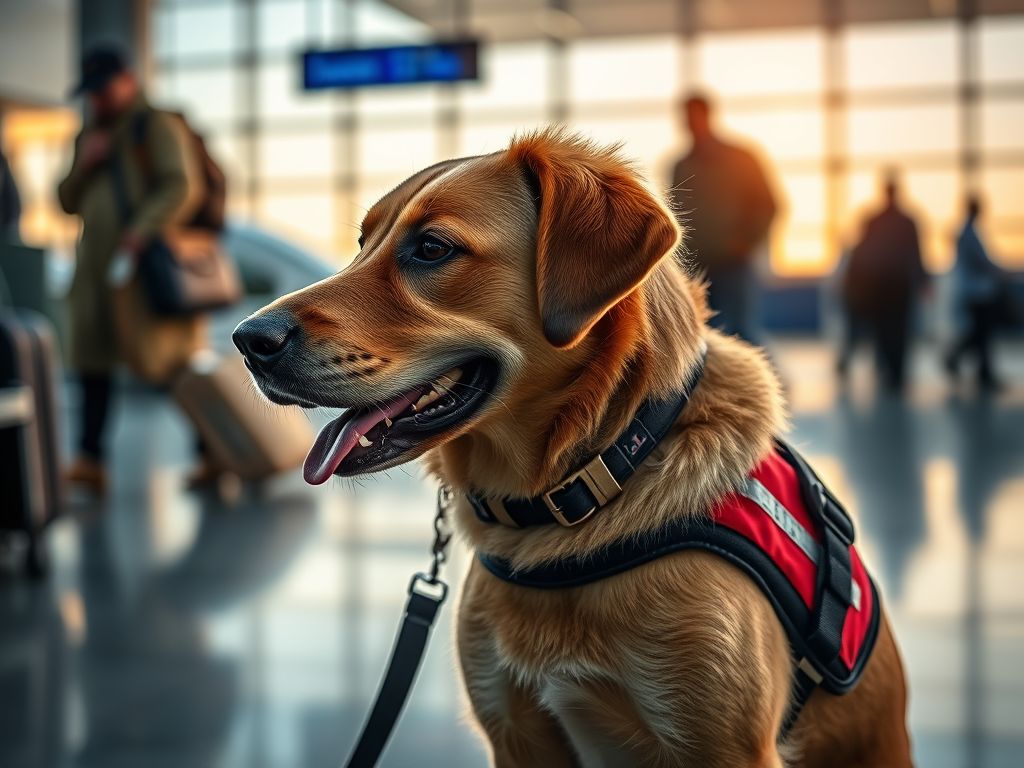
Flying with a Service Dog: A Comprehensive Guide for Handlers
- Why Service Dog Air Travel Matters
- Legal Definitions and ADA Requirements
- Key Characteristics of Legitimate Service Dogs
- Service Dogs vs. Emotional Support Animals
- Documentation and Certification
- The Air Carrier Access Act Explained
- Current DOT Rules
- Preparing for Air Travel: Documentation and Requirements
- Creating a Travel Folder
- Notifying Your Airline in Advance
- Pre-Flight Preparation: A Comprehensive Checklist
- Pre-Flight Checklist
- Navigating Airport Security and Check-In
- Tips for Smooth TSA Screening:
- In-Flight Considerations: Comfort and Behavior
- Managing Your Dog’s Comfort
- Post-Flight Considerations and Recovery
- Return Flight Preparation
- Common Mistakes to Avoid
Introduction: Why Service Dog Air Travel Matters
For millions of Americans living with disabilities, service dogs represent far more than companionship—they are essential partners that enable independence, safety, and quality of life. These highly trained animals perform critical tasks ranging from mobility assistance and seizure alert to psychiatric support and diabetic monitoring. Yet despite their vital role, traveling by air with a service dog can feel daunting for handlers who are unfamiliar with the regulations, requirements, and best practices involved.
The ability to fly with your service dog shouldn’t be a luxury reserved for the well-informed few. Whether you’re traveling for medical appointments, family emergencies, vacations, or business, your service dog should be able to accompany you without unnecessary complications or stress. Unfortunately, many handlers encounter confusion at airports, face skepticism from airline staff, or worry about their dog’s comfort and behavior during flights. Some handlers have even reported being denied boarding or subjected to invasive questioning about their dog’s qualifications.
This comprehensive guide exists to empower you with the knowledge and confidence you need to navigate air travel with your service dog smoothly and successfully. We’ll walk through everything from understanding legal definitions and airline policies to practical tips for managing security checkpoints and in-flight comfort. By the end of this article, you’ll have a clear roadmap for planning your trip, understanding your rights, and ensuring both you and your service dog have the best possible travel experience.
Understanding Service Dogs: Legal Definitions and ADA Requirements
Before discussing air travel specifics, it’s essential to understand what legally qualifies as a service dog in the United States. This distinction matters significantly because it determines your rights and protections under federal law.
The ADA Definition
Under the Americans with Disabilities Act (ADA), a service dog is defined as a dog that has been individually trained to perform specific tasks or do work directly related to a person’s disability. The key word here is “trained.” The ADA does not recognize emotional support animals, comfort animals, or therapy dogs as service animals for the purposes of public access rights, though these distinctions become more nuanced in air travel contexts (which we’ll address later).
The tasks a service dog performs must be directly tied to the handler’s disability. For example:
- A dog trained to alert a person with diabetes to dangerous blood sugar levels
- A dog trained to guide a person who is blind
- A dog trained to alert someone to an oncoming seizure
- A dog trained to pull a wheelchair
- A dog trained to retrieve items for someone with mobility limitations
- A dog trained to provide deep pressure therapy during a panic attack or PTSD episode
- A dog trained to interrupt self-harming behaviors
Key Characteristics of Legitimate Service Dogs
Legitimate service dogs typically share several characteristics:
Individual Training: Service dogs undergo extensive, specialized training—often 18 months to two years or more—from professional trainers or training organizations. This training is customized to the handler’s specific disability and needs. The dog learns not just to perform tasks, but to do so reliably, safely, and in various environments.
Task-Specific Skills: The dog has been trained to perform at least one specific task related to the handler’s disability. This is what distinguishes service dogs from emotional support animals. A service dog doesn’t simply provide comfort through its presence; it actively performs trained work.
Behavioral Standards: Service dogs are trained to behave appropriately in public settings. They should be under control, non-aggressive, and focused on their handler. A well-trained service dog should not be disruptive, reactive, or a safety concern to others.
Handler Dependency: The dog works specifically for one handler and is not a general-purpose animal. The relationship is built on the dog’s training to respond to that particular person’s needs.
Important Distinctions
Service Dogs vs. Emotional Support Animals (ESAs): This is a critical distinction that confuses many people. Emotional support animals provide comfort through their presence but are not trained to perform specific tasks. Under the ADA, ESAs do not have the same public access rights as service dogs. However, under the Air Carrier Access Act (ACAA), which governs air travel, the rules are different—we’ll discuss this in detail in the next section.
Service Dogs vs. Therapy Dogs: Therapy dogs are trained to provide comfort to multiple people in settings like hospitals, nursing homes, or schools. They are not trained for a specific individual’s disability-related tasks.
Service Dogs vs. Pets: While service dogs are dogs, not all dogs are service dogs. A pet dog, no matter how well-behaved or beloved, does not have the legal status or public access rights of a service dog.
Documentation and Certification
Here’s an important point that surprises many people: under the ADA, there is no official certification, registration, or licensing requirement for service dogs. The ADA does not mandate that service dogs wear vests, ID cards, or any particular identifying gear. This is intentional—the law recognizes that requiring official documentation could create barriers for people with disabilities, particularly those who train their own service dogs or work with smaller training organizations.
However, this lack of official certification creates challenges, particularly in air travel. Airlines cannot legally require ADA certification (because it doesn’t exist), but they can ask specific questions about the dog’s training and tasks. We’ll discuss how to handle these questions later.
Many handlers find it helpful to have documentation from their trainer, veterinarian, or healthcare provider describing the dog’s training and tasks, even though this isn’t legally required. This documentation can be useful when traveling, though it’s important to understand your rights and not feel pressured to provide more than necessary.
Air Travel and Service Dogs: The Air Carrier Access Act
While the ADA governs service dog access in most public spaces, air travel is regulated under a different federal law: the Air Carrier Access Act (ACAA). Understanding this distinction is crucial because the ACAA has different rules than the ADA, and these rules have evolved significantly in recent years.
The Air Carrier Access Act Explained
The ACAA, enacted in 1986, prohibits discrimination against passengers with disabilities and requires airlines to make reasonable accommodations. Importantly, the ACAA’s definition of service animals is broader than the ADA’s definition. Under the ACAA, airlines must allow both service dogs and emotional support animals (ESAs) to travel in the cabin with their handlers at no additional charge.
However, this has created significant challenges. The broad definition led to widespread abuse, with people bringing untrained pets onto planes and claiming them as service animals or emotional support animals. This resulted in numerous incidents of aggressive animals, animals relieving themselves in the cabin, and disruptions to other passengers. In response, the Department of Transportation (DOT) issued new rules effective January 2021 that tightened requirements for service animals and essentially eliminated the in-cabin cabin access for emotional support animals.
Current DOT Rules (Effective January 2021)
Under the current regulations, only dogs (and in rare cases, miniature horses) can be recognized as service animals for air travel purposes. The dog must be individually trained to perform tasks or do work directly related to the handler’s disability. This aligns more closely with the ADA definition.
Importantly, the new rules state that airlines can require documentation of the service dog’s training and the handler’s disability. Airlines can use the DOT’s official form (Form DOT F 1571-E) to request this information, though they cannot require it before allowing the dog to board—they can only request it after the fact if they have reason to believe the animal is not a legitimate service dog.
Airlines can also deny boarding to a service dog if:
- The dog poses a direct threat to the health or safety of others
- The dog is not under control
- The dog has not been trained to perform tasks related to the handler’s disability
- The handler cannot control the dog or the dog is not housebroken
What This Means for Your Travel
The current rules provide important protections for legitimate service dog handlers while also giving airlines tools to address fraudulent claims. If you have a legitimate service dog that is well-trained and under control, you have the right to bring your dog in the cabin with you at no additional charge. You should not be charged a pet fee, and your dog should not be required to stay in a carrier.
However, you may be asked to provide documentation, and you should be prepared to answer questions about your dog’s training and tasks. It’s important to answer these questions honestly and directly. Airlines are looking to distinguish between legitimate service dogs and pets being misrepresented as service animals.
Preparing for Air Travel: Documentation and Requirements
Gathering Your Documentation
While airlines cannot legally require ADA certification (because it doesn’t exist), having solid documentation can smooth your travel experience significantly. Here’s what you should consider gathering:
Letter from Your Trainer or Training Organization: If your service dog came from a professional training organization, request a letter on their letterhead that describes the dog’s training, the specific tasks trained, and confirmation that the dog is a service dog trained to perform disability-related work. This is one of the most valuable documents you can have.
Letter from Your Healthcare Provider: A letter from your doctor, psychiatrist, therapist, or other healthcare provider describing your disability and confirming that you have a service dog can be helpful. This doesn’t need to go into detail about your specific disability (you have privacy rights), but it should confirm that you have a disability and that you have a service dog trained to assist you.
Veterinary Records: Current vaccination records and a health certificate from your veterinarian are essential, particularly if you’re traveling internationally or if an airline requests health documentation. Some airlines may require a health certificate dated within a certain timeframe (often 10 days) before travel.
Training Documentation: If you trained your own service dog, documentation of the training process can be helpful. This might include training logs, certificates from training classes, or correspondence with trainers who assisted you.
DOT Form F 1571-E: Familiarize yourself with the DOT’s official form for service animal documentation. While airlines cannot require this form before boarding, understanding what information it requests can help you be prepared to answer questions.
Creating a Travel Folder
Organize all your documentation in a dedicated folder (physical or digital) that you can easily access at the airport. Include:
- Copies of your service dog’s vaccination records
- Health certificate (if required)
- Letter from trainer or training organization
- Letter from healthcare provider
- Your airline confirmation and booking information
- Contact information for your airline’s disability services department
- A copy of the DOT regulations (for reference if needed)
- Photos of your service dog (helpful for identification)
Having everything organized and readily available demonstrates that you’re a responsible handler and can help prevent delays or complications.
Notifying Your Airline in Advance
While you are not required to notify airlines in advance that you’ll be traveling with a service dog, many handlers find it helpful to do so. Here’s why:
Advance Notice Benefits:
- Allows the airline to note your reservation and prepare staff
- Gives you an opportunity to speak with disability services staff who may be more knowledgeable than gate agents
- Allows you to request specific accommodations if needed (such as seating near an exit for easier access)
- Creates a paper trail if any issues arise
How to Notify:
- Call the airline’s disability services department directly (most major airlines have dedicated lines)
- Provide your confirmation number and flight details
- Explain that you’ll be traveling with a service dog
- Ask if they need any documentation in advance
- Request any specific accommodations you might need
Important: Do not allow an airline to tell you that you must provide documentation before boarding. You have the right to board with your service dog. Documentation can be requested after the fact if the airline has concerns, but it cannot be a prerequisite for boarding.
Pre-Flight Preparation: A Comprehensive Checklist
Physical Preparation for Your Service Dog
Exercise and Bathroom Breaks: In the days leading up to your flight, maintain your service dog’s regular exercise routine. On the day of travel, ensure your dog has adequate exercise before heading to the airport. A tired dog is generally a calmer dog, which is beneficial for air travel. Make sure your dog has had a bathroom break shortly before arriving at the airport.
Feeding Schedule: Consider your dog’s feeding schedule in relation to your flight time. Many handlers prefer to feed their service dog a lighter meal or skip a meal before flying to reduce the likelihood of digestive issues during the flight. Discuss this with your veterinarian if you’re unsure about the best approach for your dog.
Medications: If your service dog takes any medications, ensure you have an adequate supply for your trip plus extra. Keep medications in their original labeled containers. Pack them in your carry-on bag, not checked luggage, in case your checked bags are delayed.
Grooming: Bathe and groom your service dog before travel. A clean dog is more pleasant for everyone on the plane and may be less likely to trigger allergies in nearby passengers. Trim nails, clean ears, and ensure your dog’s coat is well-maintained.
Gear and Equipment Preparation
Service Dog Vest or Harness: While not legally required, many handlers choose to have their service dog wear a vest or harness that identifies them as a service dog. This can help prevent confusion and reduce questions from airport staff. Ensure the vest or harness is clean and in good condition. Make sure it fits properly and doesn’t restrict your dog’s movement or comfort.
Leash and Collar: Bring a sturdy, well-maintained leash and collar. Your dog should be on-leash or under control at all times in the airport and on the plane. Consider bringing a backup leash in case the primary one breaks.
Portable Water Bowl: Bring a collapsible water bowl so you can offer your dog water during layovers or at the airport. Staying hydrated is important for your dog’s comfort and health during travel.
Waste Bags: Pack plenty of waste bags for bathroom breaks at the airport and during layovers. You are responsible for cleaning up after your service dog immediately.
Comfort Items: Consider bringing comfort items such as a favorite toy, blanket, or chew toy. These can help keep your dog calm and occupied during the flight. However, ensure these items won’t be disruptive to other passengers.
Crate or Carrier (if needed): While your service dog should travel in the cabin with you, not in a carrier, some handlers bring a portable crate for use during layovers or if the dog needs a secure space. This is optional but can be helpful.
Health and Safety Preparation
Veterinary Check-Up: Schedule a veterinary check-up a few weeks before your trip. Ensure your dog is healthy and fit for travel. Discuss any concerns about air travel with your veterinarian. If your dog has anxiety or motion sickness, ask about potential solutions.
Microchip and ID: Ensure your service dog is microchipped and wearing an ID tag with your contact information. In the unlikely event that your dog becomes separated from you, this increases the chances of reunion.
Travel Insurance: Consider pet travel insurance that covers emergency veterinary care. While you hope you won’t need it, having coverage provides peace of mind.
Medications for Anxiety: If your service dog experiences anxiety during travel, discuss this with your veterinarian. Some vets may recommend calming supplements or, in some cases, anti-anxiety medication. Never give your dog medication without veterinary guidance.
Pre-Flight Checklist
- Service dog has had recent veterinary check-up
- Vaccinations are current and documented
- Health certificate obtained (if required)
- Microchip is current and registered
- ID tag is secure and current
- Service dog is groomed and clean
- Vest or harness is clean and fits properly
- Leash and collar are in good condition
- Waste bags are packed
- Portable water bowl is packed
- Medications are packed in carry-on
- Comfort items are packed
- Documentation folder is organized and accessible
- Airline has been notified (if desired)
- Flight confirmation is printed or accessible on phone
- Airline disability services contact information is saved
- DOT regulations are reviewed and understood
- Service dog has had exercise and bathroom break
- You have planned your airport arrival time (arrive early)
- You have identified accessible parking or drop-off at airport
Navigating Airport Security and Check-In
Arriving at the Airport
Timing: Arrive at the airport earlier than you normally would. Service dog handlers often face additional questions or procedures, and arriving early ensures you won’t be rushed. Most experts recommend arriving 2-3 hours before a domestic flight when traveling with a service dog.
Accessible Parking and Drop-Off: Use accessible parking or drop-off areas if available. This can make the journey from your vehicle to the terminal easier, especially if you’re managing luggage and your service dog.
Bathroom Break: Before entering the terminal, take your service dog to a designated relief area for a bathroom break. Most airports have designated pet relief areas, though these are typically intended for pets in carriers. As a service dog handler, you may need to find a grassy area outside the terminal or ask airport staff where you can take your dog for a bathroom break.
Check-In Process
Approaching the Counter: When you approach the check-in counter, be prepared to mention that you’re traveling with a service dog. You do not need to provide documentation at this point unless the airline specifically requests it.
What to Expect: The check-in agent may ask questions about your service dog, such as:
- Is this a service dog?
- What tasks does your dog perform?
- Is your dog trained to perform tasks related to your disability?
Answer these questions honestly and directly. You don’t need to provide extensive detail about your disability, but you should be able to briefly describe the tasks your dog performs.
Documentation: If the agent asks for documentation, you can provide it. However, understand that airlines cannot require documentation before allowing you to board. If an agent insists on documentation before boarding, politely but firmly explain that under the Air Carrier Access Act, you have the right to board with your service dog. You can offer to provide documentation after boarding if they have concerns.
No Pet Fees: Confirm that no pet fees are being charged. Service dogs should travel at no additional cost. If a fee is being added to your ticket, ask to speak with a supervisor or the airline’s disability services department.
TSA Security Screening
This is often the most stressful part of air travel for service dog handlers, but understanding the process can help you navigate it smoothly.
TSA Rules for Service Dogs: The TSA allows service dogs to pass through security screening with their handlers. Service dogs do not need to go through the X-ray machine or metal detector separately. However, they may be subject to additional screening.
The Screening Process:
- Inform the TSA Officer: When you approach the security checkpoint, inform the TSA officer that you have a service dog. This alerts them to adjust their screening procedures.
- Keep Your Dog Close: Keep your service dog on-leash and close to you throughout the screening process. Your dog should remain under your control at all times.
- Walk Through the Metal Detector: You and your service dog will walk through the metal detector together. Your dog does not need to be removed from their leash or vest.
- Additional Screening: TSA officers may conduct additional screening of your service dog. This might include:
- A visual inspection of the dog
- Petting or touching the dog to check for concealed items
- Swabbing the dog’s paws or fur for explosive residue
- Asking questions about the dog
- Behavioral Expectations: Your service dog should remain calm and well-behaved during screening. If your dog is reactive or aggressive, this may cause delays or complications. If your dog is anxious about being touched, you can request that the officer minimize contact, though some screening may still be necessary.
- Your Belongings: Your carry-on bags, shoes, and other items will go through the X-ray machine as usual. You may need to temporarily separate from your dog during this process, but you should be able to see your dog and reunite quickly.
Tips for Smooth TSA Screening:
- Arrive early so you’re not rushed
- Keep your dog calm and under control
- Be cooperative with TSA officers
- Have your ID and boarding pass ready
- Remove your dog’s vest if it has metal components that might trigger the metal detector
- If your dog is anxious, practice going through metal detectors before your trip if possible
- Stay calm yourself—dogs pick up on handler anxiety
If You Have Concerns: If you feel that TSA screening is being conducted inappropriately or if you have concerns about your dog’s safety, you can:
- Ask to speak with a TSA supervisor
- Request that a companion be present during screening
- File a complaint with the TSA after your trip
- Contact your airline’s disability services department
Moving Through the Airport
Finding Relief Areas: Once you’ve cleared security, locate a designated pet relief area or find an appropriate outdoor space where your service dog can have a bathroom break. Many airports have designated relief areas, though you may need to ask airport staff for directions.
Staying Hydrated: Offer your service dog water from your portable bowl. Staying hydrated is important, especially if you have a layover or if your flight is delayed.
Remaining Calm: Try to keep your service dog calm as you move through the airport. Airports are busy, loud, and stimulating environments. Keeping your dog close, maintaining a calm demeanor, and avoiding unnecessary interactions with other travelers can help keep your dog relaxed.
Boarding Area: When you reach your gate, find a quiet area to wait if possible. Some airports have family or accessible seating areas that may be quieter than the main gate area. Keep your dog close and under control.
In-Flight Considerations: Comfort and Behavior
Boarding the Aircraft
Timing: You may be offered early boarding as a passenger with a disability. This can be beneficial because it allows you to board before the cabin gets crowded, giving you time to settle your dog and get situated without feeling rushed.
Seating: When you board, inform the flight attendant that you have a service dog. If you haven’t already selected a seat, request a seat that will work well for you and your dog. Aisle seats are often preferable because they provide more space and easier access for bathroom breaks if needed.
Settling In: Once you’re seated, help your dog settle into the space under your seat or at your feet. Your dog should remain on-leash or under your control throughout the flight. The space under the seat in front of you is typically where service dogs stay during flight.
In-Flight Behavior Expectations
Remaining Calm and Quiet: Your service dog should remain calm and quiet during the flight. The dog should not bark, whine, or be disruptive to other passengers. If your dog is anxious or prone to vocalization, work with a trainer before your trip to address these behaviors.
Staying in Place: Your dog should remain in the designated space (typically under your seat) throughout the flight. The dog should not wander the cabin, approach other passengers, or leave the immediate area around your seat without your direction.
No Interactions with Other Passengers: While other passengers may want to pet or interact with your service dog, discourage these interactions. Your dog is working and should remain focused on you. Politely but firmly explain that your dog is a working service animal and should not be distracted.
Bathroom Breaks: Service dogs are trained to hold their bladder for extended periods, but long flights may require a bathroom break. If your dog needs a bathroom break during the flight, inform a flight attendant. They can direct you to the lavatory. Use the lavatory to allow your dog to relieve themselves in the toilet or on absorbent pads you’ve brought. Clean up thoroughly and wash your hands.
Managing Your Dog’s Comfort
Temperature: Aircraft cabins can be cool. If your dog seems cold, you can bring a blanket or sweater. However, ensure your dog doesn’t overheat, as cabins can also be warm.
Hydration: Offer your dog water periodically during the flight. You can ask flight attendants for water or bring a collapsible bowl and bottled water.
Comfort Items: If you’ve brought comfort items like a favorite toy or blanket, these can help keep your dog calm and occupied. However, ensure these items won’t be disruptive to other passengers.
Anxiety Management: If your dog seems anxious, remain calm and provide reassurance. Petting and talking to your dog in a calm voice can help. If your dog is severely anxious, the calming techniques you’ve practiced beforehand can be helpful.
Exercise: While your dog can’t exercise much during the flight, you can do gentle stretching or massage to help your dog stay comfortable.
Communicating with Flight Attendants
Inform Them Early: Let flight attendants know that you have a service dog as soon as you board. This alerts them to your situation and allows them to provide appropriate assistance if needed.
Be Respectful: Flight attendants are there to help, but they’re also managing many passengers. Be respectful of their time and follow their instructions regarding safety procedures.
Ask for Help if Needed: If you need assistance with anything related to your service dog, don’t hesitate to ask. Flight attendants can help direct you to lavatories, provide water, or assist with other needs.
Address Issues Promptly: If another passenger is bothering your dog or if there are any concerns, inform a flight attendant promptly so they can address the situation.
Handling Disruptions or Challenges
If Your Dog Becomes Ill: If your dog becomes ill during the flight, inform a flight attendant immediately. They can provide assistance and may be able to divert to the nearest airport if necessary. Have your veterinarian’s contact information available.
If Your Dog Has an Accident: If your dog has an accident in the cabin, clean it up immediately using supplies you’ve brought. Inform a flight attendant so they can assist with additional cleaning if needed. This is embarrassing but can happen, and flight crews are trained to handle these situations.
If Another Passenger Complains: If another passenger complains about your service dog, remain calm and professional. Flight attendants will handle the situation. Your service dog has the legal right to be in the cabin, and you should not be made to feel unwelcome.
If You Feel Discriminated Against: If you feel that you or your service dog are being treated unfairly or discriminated against, remain calm, document the incident (including names of staff members and times), and file a complaint with the airline and the DOT after your trip.
Post-Flight Considerations and Recovery
Immediately After Landing
Bathroom Break: As soon as you’ve deplaned and cleared the gate area, take your service dog to a designated relief area for a bathroom break. Your dog has likely been holding their bladder for several hours and will need to relieve themselves.
Hydration and Food: Offer your dog water and, if appropriate, food. Your dog may be hungry and thirsty after the flight.
Check for Issues: Examine your dog for any signs of stress, injury, or illness. Check paws, ears, and skin for any problems that may have occurred during travel.
Calm Environment: If possible, find a quiet area where your dog can decompress after the stimulation of air travel. Your dog may be tired and need time to settle.
Baggage Claim and Ground Transportation
Retrieving Luggage: Proceed to baggage claim to retrieve your checked luggage. Keep your service dog close and under control throughout this process.
Ground Transportation: If you’re renting a car, taking a taxi, or using rideshare, ensure that your service dog is accommodated. Most transportation services must allow service dogs, but it’s helpful to mention this when booking.
Hotel or Destination: When you arrive at your hotel or destination, allow your dog time to adjust to the new environment. Take your dog for a bathroom break and a walk to help them settle.
Health Check After Travel
Veterinary Evaluation: If your trip was long or if you notice any signs of stress or illness in your dog, consider scheduling a veterinary check-up within a few days of your return. Air travel can be stressful, and it’s good to ensure your dog is healthy.
Behavioral Changes: Monitor your dog for any behavioral changes after travel. Some dogs may be more anxious or tired for a few days after flying. This is normal, but if changes persist, consult your veterinarian.
Return to Routine: Resume your normal routine with your service dog as soon as possible. Regular exercise, feeding schedules, and training help your dog readjust after travel.
Return Flight Preparation
If you’re flying back home, repeat the pre-flight preparation steps. Your dog may be more familiar with the process the second time, which can make the return flight smoother.
Frequently Asked Questions and Common Mistakes
Frequently Asked Questions
Q: Can I be charged a pet fee for my service dog?
A: No. Under the Air Carrier Access Act, service dogs travel in the cabin at no additional charge. If an airline attempts to charge you a pet fee, this is a violation of federal law. Politely but firmly refuse and ask to speak with a supervisor or the airline’s disability services department.
Q: Do I need to provide certification or documentation before boarding?
A: No. There is no official ADA certification for service dogs. Airlines cannot require documentation before boarding. However, they can request documentation after the fact if they have reason to believe the animal is not a legitimate service dog. Having documentation available can be helpful, but you cannot be denied boarding based on lack of documentation.
Q: What if my service dog is anxious about flying?
A: Work with a trainer or behaviorist before your trip to address anxiety. Practice desensitization exercises, such as visiting the airport or practicing going through metal detectors. Your veterinarian may recommend calming supplements or, in some cases, anti-anxiety medication. Never give your dog medication without veterinary guidance.
Q: Can my service dog stay in a carrier during the flight?
A: Your service dog should not be required to stay in a carrier. Service dogs travel in the cabin with their handlers, typically in the space under the seat in front of you. However, if your dog is very small and you prefer to use a carrier for comfort, you may do so, though this is not required.
Q: What if my service dog needs a bathroom break during the flight?
A: Inform a flight attendant, and they can direct you to the lavatory. You can allow your dog to relieve themselves in the toilet or on absorbent pads you’ve brought. Clean up thoroughly and wash your hands.
Q: Can I bring food and water for my service dog on the plane?
A: Yes. You can bring a collapsible water bowl and bottled water. You can also bring food for your dog, though you may prefer to feed your dog before or after the flight rather than during it.
Q: What if another passenger is bothering my service dog?
A: Inform a flight attendant immediately. They can address the situation and ensure that your dog is not being disturbed. Your service dog has the legal right to be in the cabin, and other passengers should not be allowed to interfere with your dog.
Q: Can I be denied boarding with my service dog?
A: Airlines can deny boarding to a service dog only if the dog poses a direct threat to health or safety, is not under control, has not been trained to perform tasks related to the handler’s disability, or the handler cannot control the dog or the dog is not housebroken. These are narrow exceptions, and legitimate, well-trained service dogs should not be denied boarding.
Q: What if I’m flying internationally with my service dog?
A: International travel with a service dog is more complex and varies by country. You’ll need to research the specific requirements of your destination country, which may include health certificates, vaccinations, microchipping, and import permits. Contact your airline and the embassy or consulate of your destination country for specific requirements.
Q: Can I bring my emotional support animal (ESA) in the cabin?
A: Under current DOT regulations (effective January 2021), only dogs and miniature horses that are trained to perform tasks related to a disability can travel in the cabin. Emotional support animals that are not trained to perform specific tasks are no longer allowed in the cabin. They must be transported as checked baggage or cargo.
Common Mistakes to Avoid
Mistake 1: Not Preparing Your Dog for Travel
Many handlers assume their well-trained service dog will automatically be comfortable flying. However, air travel is a unique experience that can be stressful for dogs. Practice desensitization exercises, visit the airport, and work with a trainer to prepare your dog for the experience.
Mistake 2: Arriving Late to the Airport
Service dog handlers often face additional questions or procedures. Arriving late can result in a rushed, stressful experience. Arrive 2-3 hours early for domestic flights to allow time for check-in, security screening, and bathroom breaks.
Mistake 3: Not Having Documentation Organized
While you cannot be denied boarding based on lack of documentation, having organized, accessible documentation can smooth your travel experience. Create a dedicated folder with all relevant documents and keep it easily accessible.
Mistake 4: Misrepresenting Your Dog’s Status
Never claim that a pet is a service dog or that a pet is trained to perform tasks it hasn’t been trained to perform. This is fraud and undermines the credibility of legitimate service dog handlers. It also contributes to the stigma and skepticism that legitimate handlers face.
Mistake 5: Allowing Your Dog to Interact with Other Passengers
While your dog may be friendly and other passengers may want to pet your dog, your dog is working and should remain focused on you. Politely but firmly discourage interactions with other passengers.
Mistake 6: Not Informing Flight Attendants About Your Service Dog
Let flight attendants know about your service dog as soon as you board. This alerts them to your situation and allows them to provide appropriate assistance if needed.
Mistake 7: Not Having a Backup Plan
If your flight is cancelled or delayed, have a plan for your dog’s care. Know where relief areas are, have water and food available, and know how to contact your airline’s disability services department if issues arise.
Mistake 8: Not Addressing Behavioral Issues Before Travel
If your dog has behavioral issues such as anxiety, reactivity, or excessive vocalization, address these before flying. A dog that is anxious or reactive can make the flight stressful for you, your dog, and other passengers.
Mistake 9: Assuming All Airlines Have the Same Policies
While all airlines must comply with federal law, specific policies and procedures can vary. Research your specific airline’s policies and contact their disability services department if you have questions.
Mistake 10: Not Documenting Incidents
If you experience discrimination or mistreatment, document the incident including the date, time, names of staff members involved, and details of what occurred. This documentation can be valuable if you need to file a complaint or pursue further action.
Conclusion: Empowering Your Journey
Flying with a service dog should not be a source of anxiety or stress. Your service dog is a trained professional, a vital partner in your independence and safety, and a legitimate traveler with legal protections. By understanding your rights, preparing thoroughly, and approaching air travel with confidence and knowledge, you can ensure that both you and your service dog have a positive travel experience.
Remember these key points as you plan your air travel:
You Have Rights: Under the Air Carrier Access Act, you have the legal right to travel with your service dog in the cabin at no additional charge. Service dogs are not pets; they are working animals with specific legal protections.
Preparation is Key: Thorough preparation—from training your dog for the travel experience to organizing your documentation to arriving early at the airport—can prevent most travel complications.
Knowledge is Power: Understanding the regulations, your rights, and what to expect at each stage of the travel process empowers you to navigate air travel confidently and advocate for yourself if issues arise.
Your Dog is Ready: If your service dog is well-trained and under control, your dog is ready for air travel. Trust in your dog’s training and your ability to manage the experience.
You’re Not Alone: Many service dog handlers travel by air successfully every day. If you have questions or concerns, reach out to your trainer, your airline’s disability services department, or disability advocacy organizations for support and guidance.
Air travel with a service dog is absolutely possible and, with proper preparation, can be a smooth and positive experience. Your service dog has been trained to work in various environments and situations, and air travel is just another environment where your dog can perform their important work. By following the guidance in this comprehensive guide, you’ll be well-prepared to navigate every stage of the travel process with confidence.
Whether you’re traveling for medical appointments, family emergencies, vacations, or business, your service dog should be able to accompany you without unnecessary complications. You deserve to travel with the same ease and confidence as any other passenger, and your service dog deserves to be recognized and respected as the working professional they are.
Safe travels to you and your service dog. Your journey matters, and you have the knowledge and rights to make it a successful one.
Flying with your pet takes planning — but you don’t have to do it alone.
If this guide helped, share it with another pet parent, and follow Pet Travel Planner for more expert tips, airline updates, and stress-free pet travel advice.


